




When you hear behavioral health revenue cycle management (RCM), you probably experience one of two reactions: Shudders and maybe some screams, thinking about all of the lost revenue from the last year (or dare we mention the potential write-offs for this fiscal year), or throwing your hands up in defeat because you’re tired of the constant game of chase.
It’s not that your RCM teams aren’t doing their best. Or that your agency is flawed. It’s that the systems community-based care teams work in are designed for ideal scenarios—not the real challenges your staff face every day.
Financial leaders for community-based care are stuck between a rock and a hard place: Delivering services requires billing payers, but getting paid requires a perfect claim—and we all know perfect claims (without rework or upstream correction 😉) are nonexistent. And once denied, 50-65% of denials are never reworked—they’re just written off. Written off because you are so busy focusing on making claims perfect, or reworking them to perfection, you don’t have time to work denied claims over 120 days. That’s the rock. The hard place is the massive gap hiding in self-pay collection, with 54% of self-pay AR sitting at well over 120 days—and all that potential coverage missing from verification.
The path from “client walks in” to “money in the bank” is longer, more fragile, and more human than most people realize, which means the opportunity for error or denial exists at every step. So this post is going to walk you through every step of a behavioral health RCM claim, every human it touches, and crucially, where it’s most likely to die before it ever reaches a payer.
The Lifecycle of a Behavioral Health Claim
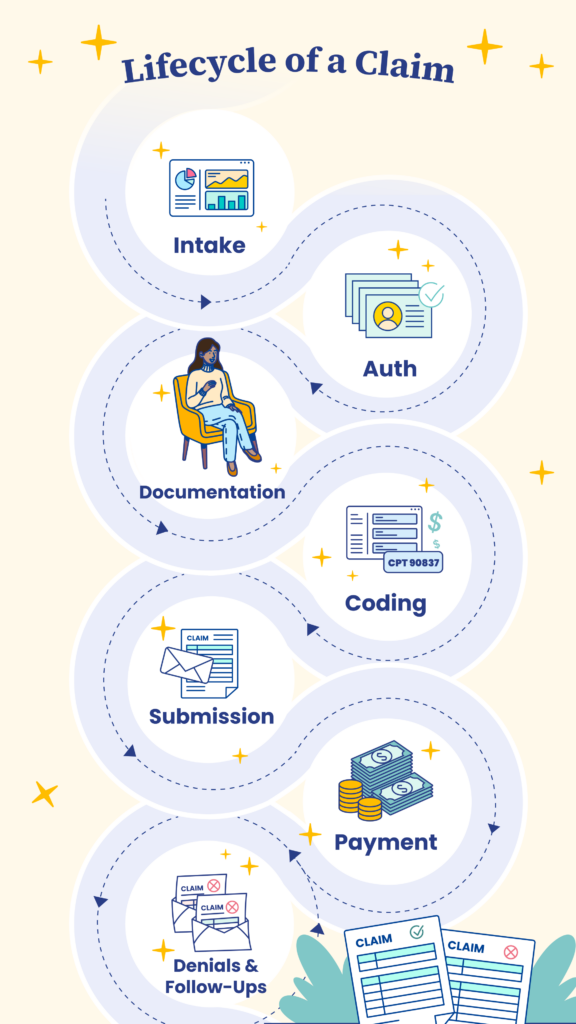
Every claim walks through seven steps on its way to being paid. The goal is for the path to be seven steps to claim success, but the reality is a bit more complicated than that.
The actual steps your claims walk through.
The sequence moves from step 1 to 2, and all the way through 7, but each stop on the path must be handled with care. Miss something at any one of them and the claim stalls, shrinks, or disappears entirely. Most executives and non-RCM pros assume claims fail at submission or in denials. But it turns out the real damage happens much earlier, well before a claim becomes a billable service.
The humans behind every claim.
You know who is involved in making the RCM engine run. But sometimes a refresher doesn’t hurt. Meet the cast of claim processing:
CLIENT → The person seeking care; the reason we all do what we do.
CLINICIAN → Therapist, prescriber, case manager. The human who writes the note that turns into a claim.
INTAKE SPECIALIST → Captures demographics & insurance, ideally before the session.
AUTH COORDINATOR → Gets payer to say yes before services are rendered or billed.
CREDENTIALING SPECIALIST → Keeps clinicians and orgs enrolled with payers.
BILLING SPECIALIST → Pushes claims out the door. Fixes what’s broken, when they can catch it.
AR SPECIALIST → Works denials. Calls payers. Chases (and chases…and chases) aged claims.
DIRECTOR OF RCM → Owns it all. And likely loses sleep over every broken step.
Each person owns a piece of the claim’s journey—and a gap in any one role turns into lost revenue. But you know that already. What you don’t always know is where the claim is breaking down, and who can stop it from breaking in the first place.
Where Behavioral Health Claims Break
Let’s start with some stats:
80% of preventable behavioral health denials trace to errors that happened before the claim ever left the building.
Two critical failure points dominate claim breakdowns, eligibility (or stage 1) and documentation, stage 3. The backend of claim processing—denials, appeals, AR follow-up—gets all the attention, but it’s the most expensive place to fix a problem (if it can be fixed at all.) The cheapest dollar an RCM team saves is the one caught upstream, before submission occurs, before the claim leaves your ecosystem. But more on that below.
Your first critical breakpoint: Eligibility mistakes.
Insurance verification usually happens at client intake. And then it is often considered done, the box checked for good. But Medicaid changes monthly—and with new work requirements and H.R.1 considerations, Medicaid verification just got much harder, and much more important. Verifying insurance at intake and never again creates a false sense of security that many agencies fall into.
The result of this false sense of security? Claims denied for no active coverage on date of service (32% of denials) and wrong MCO billed (23% of denials.) That’s more than 50% of claim denials, all stemming from a false safety net in eligibility. 😬
Then there’s the self-pay blind spot. Most CMHCs and CCBHCs have a self-pay population, but many of those patients actually have Medicaid or Medicare that was never disclosed or found. That undetected coverage quietly becomes $800K–$1.5M in annual write-offs for mid-sized agencies.
But it doesn’t have to. Learn more about Eleos’ Eligibility Intelligence solution.
How AI (like Eleos) Helps Orgs Like Yours Fix Eligibility:
Automated eligibility tools can run weekly batch checks across the entire caseload without relying on manual portal logins. Instead of a human going from portal to portal, hunting for a needle in a haystack, AI checks all of your clients in minutes.
And discovery functionality finds hidden coverage on patients labeled self-pay, converting uncompensated visits (like those 120-day old ones in your dead claim bucket) into billable ones before anyone has to chase them
Imagine what your org could do with found revenue in the hundreds of thousands—or even millions. More locations. More clinicians. More clients. Better care. Better outcomes. The opportunities are nearly endless.
Critical breakpoint number 2: Documentation failures.
There’s a saying in behavioral health, “If the session wasn’t documented, did it even happen?” Of course, the session happened. But if the note isn’t signed, the session doesn’t exist in the billing system. It sounds so obvious, but notes do sometimes go unsigned and slip through the cracks.
After about seven days without a signature, it becomes a failed activity. After 90 days, it may exceed timely filing limits and become permanently unbillable—revenue that can never be recovered. All because a very busy, likely overwhelmed clinician forgot to finish submitting the note.
It’s not malicious. But documentation lag is the single biggest revenue leak in behavioral health, and it’s invisible until it’s too late.
But even if a note is signed and submitted, there are still several potential opportunities for a note to fail the payer test. From a coding perspective, the note has to make clear who delivered the service, whether that clinician has the credentials to deliver that length of time, and how long the session really was—does it qualify as 45 minutes or 55 minutes? An accidental coding mistake can kill a claim in an instant, and your team is likely to not find out until weeks (or months) later.
How Technology Can Help with Documentation:
Oh let us count the ways! Documentation is one of the easiest ways to inject AI into your workflows and see immediate results. And I’m not just talking about clinician wellbeing.
But ambient documentation solutions aren’t new in 2026. What is new(ish) is agentic AI, like Live Quality Assist that flags missing elements in real-time, before the note is signed, so issues are caught in the moment rather than discovered three months later, in a denial. And coding guidance means providers get recommendations based on the context of the session—not a conservative default that leaves revenue on the table.
Technology’s Real Role in Upstream Revenue Protection
Before we can talk about technology’s role in protecting revenue upstream before you submit claims, we have to talk about the human role. Shifting upstream isn’t just a software calibration, but an entire mindset shift at an agency. Every role, every level, every department. We, as an industry, have to stop thinking, “How do we work denials faster?” and start saying, “How do we stop them from happening?”
We have to stop thinking about systems of record and start thinking about systems of action.
Eleos is an AI company. We operate with an AI-first mentality across our org. But we also operate under a firm belief: Technology doesn’t replace people—it augments them. It’s why we talk about augmented intelligence, not just artificial intelligence.
For RCM, AI and technology (and this mindset shift) has the possibility of moving the work earlier, where it is cheaper and faster to fix. Because solutions like Eleos operate at both upstream gates: Eligibility intelligence before the visit, documentation and coding support during and immediately after. Real-time insights while your clinicians document the session. (And Medicaid work requirement flags that help your clinicians help their clients keep critical coverage.)
The downstream effect of this upstream shift is cleaner claims and lower denial rates. Win and win. Shorter days-in-AR and less AR the team has to manually chase. Win and win.
Oh, and happier teams who can do the work they were hired to do. Win and win.
“Eleos is a game changer in eligibility automation, we saw a 8.5x ROI on our investment.”
Sarah Stockwell, CFO Crosswinds
The claim lifecycle is a system—and systems break if not properly maintained or supported. For most behavioral health orgs that breakpoint isn’t actually in the billing department. It’s well upstream, potentially even before the session happened.
Where in your revenue cycle are claims most often stalling—and when are you catching it? Talk to an expert to find out how Eleos can help.