





It’s no secret that Eleos can reduce overall documentation time and empower providers to better measure and reflect on their sessions. But did you know that it can also improve therapeutic outcomes?
At least, that’s what the research suggests.
At the Ozark Center in Joplin, MO, where this study was conducted, the clinical team was interested in finding new ways to improve the effectiveness of their therapy sessions, which ultimately led to their partnership with Eleos.
As Del Camp, Chief Clinical Officer of Ozark Center, explained, “Anything that I can bring to the table that will enhance the clinical skill of my providers is something I want to do.”
The preliminary randomized controlled trial (RCT) compared the anxiety and depression symptoms of 23 therapy clients whose treatment was augmented with the use of Eleos to those of 24 clients undergoing treatment-as-usual. It was the first study to dig into the feasibility, acceptability, and efficacy of an AI-powered behavioral health platform using real data and therapist feedback.
The results clearly demonstrated the range of benefits Eleos provides therapists. It allowed them to:
- more easily measure and evaluate their sessions,
- reduce overall documentation time, and
- improve their clinical skills.
Providers particularly appreciated access to therapy-specific, AI-derived insights (such as a summary of the client’s concerns as described in treatment, their symptom response to treatment, and the therapist’s adherence to evidence-based practice).
Camp observed a noticeable difference in providers using Eleos: “The Ozark Center clinicians who use Eleos augmented intelligence have clients who feel better faster and stay in treatment longer than those who do not.”
Here are the study’s official results:
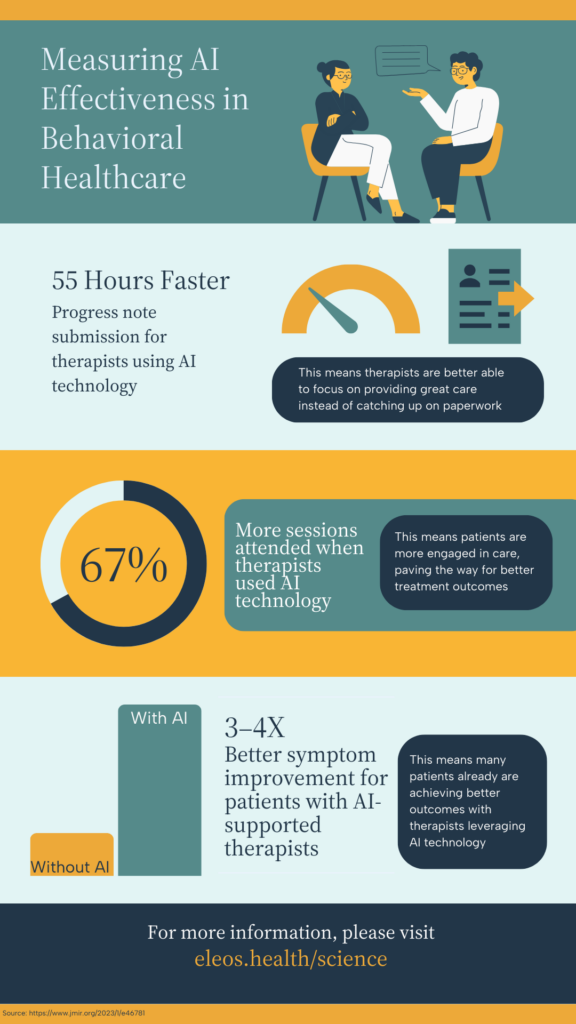
- While both groups reported high satisfaction with their therapy experience, the Eleos group attended 67% more sessions than those in the treatment-as-usual group, representing a 2x improvement in client engagement.
- Depression and anxiety symptoms were reduced by 34% and 29% in the Eleos group, as opposed to 20% and 8% for the treatment-as-usual group, representing a 3-4x better symptom reduction.
Beyond the encouraging effects on therapy outcomes, providers who used Eleos reported an improved therapy experience, recording gains in areas such as documentation time and awareness of cognitive-behavioral therapy skills utilized. Any increase in therapist efficiency and effectiveness is poised to have a significant impact, especially at a time when demand for services is at an all-time high.
On top of that, therapists who used Eleos were able to submit their completed progress notes nearly 80% faster than therapists who did not use Eleos, with AI-supported clinicians submitting within 14 hours on average versus 69 hours for the non-AI-supported clinicians (an average reduction of 55 hours or 2.3 days).
The study had some limitations, including a small sample size and a short follow-up period. More research with larger sample sizes and longer follow-up periods is needed to solidify results and determine whether and how AI platforms can be used to enhance treatment for people with severe mental illnesses.
This type of research underscores how augmented intelligence tools can enhance behavioral health. As more studies examine Eleos and similar platforms, and more clinicians start integrating these tools into their practice, the future is bright for real improvement in the effectiveness of therapy sessions.
You can read the full study here, or check out the Journal of Medical Internet Research, Vol 25, No 1 (2023): Jan-Dec.