





On Jan. 1, 2027, the financial bedrock of community-based care will experience its biggest structural change in a generation.
H.R.1, also called the One Big Beautiful Bill Act (OBBBA), will double the frequency of Medicaid redeterminations to twice a year and impose a monthly 80-hour work reporting requirement for select expansion adults. But for safety-net organizations operating on thin margins, H.R.1’s biggest financial threat is its change to retroactive billing windows, which are shrinking from 90 days for expansion adults to just 30.
On a recent webinar co-hosted with the National Council for Mental Wellbeing, Eleos Health polled 200+ industry professionals to understand their top concerns about H.R.1, and what they’re doing to protect both their revenue and care continuity.
What the data shows
Today, if a client’s Medicaid coverage lapses, organizations have three months to restore eligibility and retroactively bill for services. Under H.R.1, by the time a denied claim alerts you to a coverage lapse, the 30-day clock has almost certainly run out.
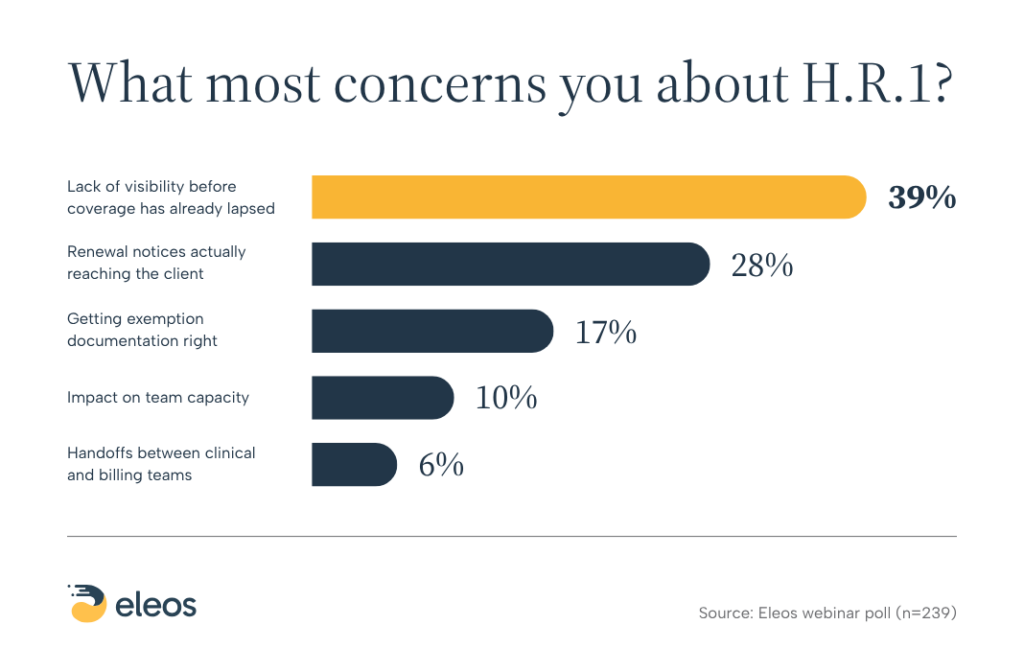
That lack of visibility is the main issue keeping behavioral health professionals up at night, with 39% of poll respondents citing it as their top concern. Other major worries include ensuring renewal notices reach clients (28%), getting exemption documentation right (17%) and managing H.R.1’s impact on team capacity (10%).
“I’m most concerned about how [H.R.1] is impacting my staff,” said Dana Royse, President and CEO of New Vista, a community mental health clinic (CMHC) and certified community behavioral health clinic (CCBHC) serving 17 counties in Central Kentucky. “I know I have to put processes in place to really help our members keep the coverage that we know they’re eligible for.”
Where redetermination workflows are breaking down
Managing redeterminations manually has always been imperfect, and it often leads to disenrollments even among individuals who are still eligible.
That’s how it played out in 2023 during the “Great Unwinding,” when states resumed regular eligibility checks for Medicaid and CHIP recipients after a multi-year pause. Over 25 million people lost coverage, and nearly 70% of them were disenrolled for procedural reasons—things like forms getting lost in the mail or paperwork sitting unprocessed for too long.
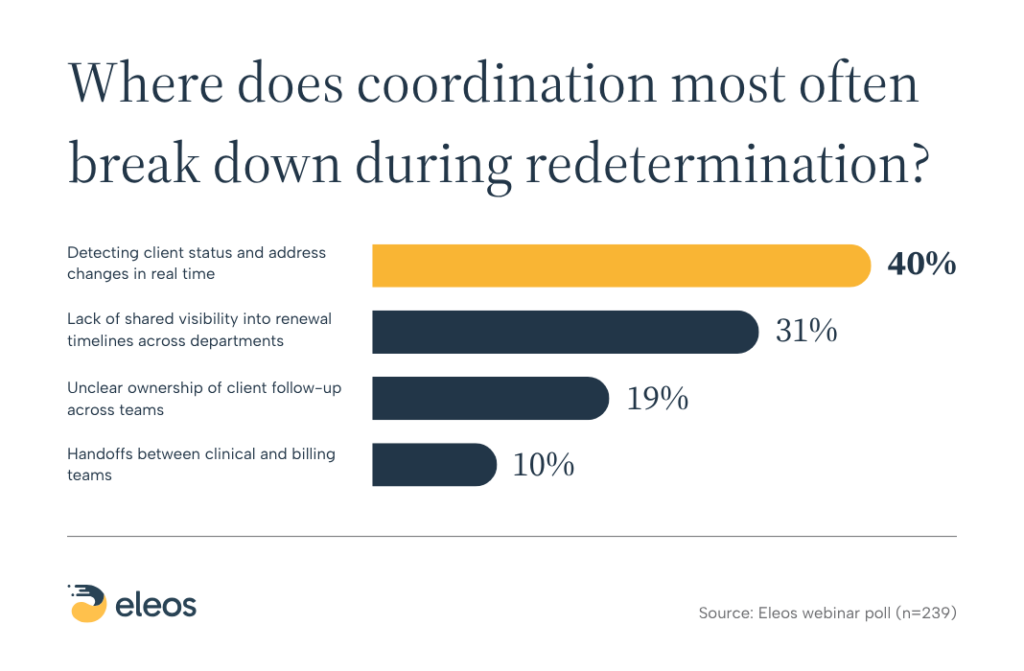
With H.R.1 doubling redeterminations to every six months, those same issues are expected to recur. The main bottleneck for redetermination workflows, poll respondents said, is limited access to real-time data:
- 40% struggle to detect client status changes (e.g., address changes) in real time
- 31% lack shared visibility into redetermination timelines across departments
- 19% face unclear ownership of client follow-up across teams
- 10% experience broken handoffs between clinical and billing teams
For care teams already stretched thin, catching those real-time status changes before the clock runs out is a steep hill to climb.
“If [clients] do miss the recertification timeline, the retroactive date that it will go back to is compressed as well,” Royse said. “Those issues are at the forefront of how we’re trying to design how we solve this problem.”
How to Get Your Organization H.R.1-Ready
Most legacy provider software, like EHRs, PM systems, RCM suites and state Medicaid portals, are static systems of record. They’re great at storing client data, but they offer zero warning when a client’s coverage is about to lapse. Under H.R.1’s 30-day retroactive window, relying solely on tools like these guarantees an influx of unbillable care.
To protect care continuity and revenue, behavioral health organizations need to establish a system of action—a proactive technology layer that automatically flags coverage risks and coordinates team workflows before services are rendered.
Building an effective system of action requires three layers:
1. A multi-source data foundation
Before your staff can take action, they need a single source of truth for client coverage status. Today, enrollment details are scattered across EHRs, state portals, clearinghouses and raw 271 eligibility response files, or EDI files.
Establishing a multi-source data foundation connects these disparate sources together, which helps care teams see whose redetermination date is approaching and when.
2. Smart workflows and team visibility
Data visibility only matters if someone is accountable for acting on it. Organizations should map client coverage risks directly to specific roles—such as care navigators, team managers and providers—so tasks get routed efficiently and teams maintain clear cross-departmental visibility over redetermination timelines.
3. Agentic automation
With staff already stretched thin, care teams don’t have the bandwidth to manually check every file, or to track changing state rules on their own.
By using AI built for community-based care to automate complex, repetitive tasks—such as continuously monitoring eligibility changes and triggering timely actions—organizations can reduce administrative overhead and ensure redetermination actions are completed on time.
Learn how Eleos can help get your organization H.R.1-ready.